Every AI architecture company gets the same question in its first serious technical review, and it is the right one to ask:
Couldn't a general-purpose model with a big context window and a project workspace just do this?
The honest answer is not "no, it can't." A frontier model can reason about your product, draft a plan, and critique a roadmap. If the bar were "produce plausible product-management text," the category would already be solved.
But that is not the bar. The bar is: turn a goal into an executable plan that is measurable, feasible against a real budget, allocated across a mix of agents and humans, and closed-looped against outcomes — deterministically, repeatably, and auditably. That is a systems problem, and systems problems are not solved by better prompts. They are solved by engines.
The core distinction runs through this entire piece, so here it is once, plainly: a model generates a plan; Meridian compiles one. Ask a model to plan toward a goal and it returns a fluent probabilistic guess — ask twice, get two different answers, with no persistent object and no arithmetic that has to balance. Give Meridian a goal and it produces a structured, persistent, arithmetic-bearing object whose numbers must add up before a single task runs. Generate versus compile is the whole difference between a demo and architecture.
This is a technical account of the engine that does the compiling.
Why a connective layer, not a smarter model
During the internet boom, all the data went online. The scarce thing was never the data — it was navigation. Search made an ungovernable data lake usable, and that connective layer captured more durable value than almost any single source on it.
The AI boom has the same shape, inverted. Navigation of static data is no longer scarce. What everyone is now accumulating is skills, agents, MCP servers, trackers, and codebases — a fragmented supply of capability. What is missing is the layer that connects all of it to deliver economic value.
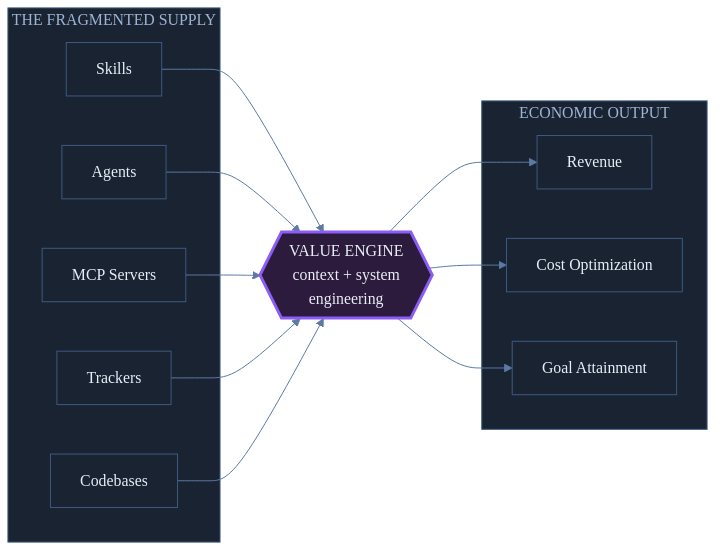
That layer is the Value Engine — a set of context-and-system-engineering algorithms drawn from proven business frameworks (OCEAN, SWOT, JTBD, KPI trees, OKRs, RTM, critical-path management), applied to one end: generating economic value for anyone building or running a business. In our product, Meridian, a master agent called Astra runs the Value Engine in a loop across concrete PM problems — market research, feature prioritization, scenario simulation, commercial-value estimation, execution tracking.
We define value operationally, as exactly one of two things:
- A market problem which, when solved, generates economic output — as revenue or cost optimization.
- A well-defined objective a builder or enterprise wants to achieve on an existing project.
These are not marketing categories. They are two different compilers, with different onboarding flows, framework stacks, and algorithm sets. The rest of this piece is what those compilers actually do.
Compiler 1: market problem → product → market
The first compiler serves early product teams and client-based IT companies starting from a market problem rather than a defined objective. The loop — Problem → Product → Market — runs continuously: ideate, analyze for fit, research the market. Here you are manufacturing signal, not tracking a known metric, so the framework stack reflects that:
- OCEAN — generate personas and a synthetic market of agents.
- SWOT — competitive mapping.
- Fletch value-mapping — positioning.
- JTBD — prioritize features out of the signal queue.
Three proprietary algorithms do the heavy lifting. Described by what they do, not how:
- ECV feature-synthesis. A probabilistic method that determines the slice of the market a feature carries commercial value for, and ranks features on that basis — a commercial verdict tied to a segment, not a score on an arbitrary scale.
- Neural EKF market synchronization. A Gaussian-scaled mixture over the OCEAN model across all synthetic agents, continuously error-corrected against reality by running OCEAN-based surveys on real users — the way an extended Kalman filter pulls a predicted state toward noisy measurements. The synthetic market is not a hallucination; it is a tracked estimate that gets more accurate every time real validation data arrives.
- Project Scenario Simulation. Graph-based critical-path management that estimates cost and timeline, auto-allocates resources, and plans around budget, timeline, or resource constraints.
This is where "a model could do it" quietly breaks. A model can describe a persona. It cannot maintain a stateful, error-corrected estimate of a market, expose it as a ranked commercial object, and feed it into a cost-constrained project graph — all as persistent, queryable state. That is a filter, a ranker, and a scheduler wired into an engine, not a prompt.
The commercial verdict is the output
Meridian does not score features in story points or RICE. It scores them in money, with an Expected Commercial Value model live in the codebase today:
ECV = (ARR_impact × P_commercial_success × P_technical_success)
      − Dev_cost
      − Opportunity_cost
The output is a verdict card, not a ranked list:
| Field | Example | Source |
|---|---|---|
| ARR at stake | $42,000 | 3 blocked deals × avg ACV + churn risk |
| Dev cost | $6,800 | 16 days × $425/day fully-loaded burn |
| Opportunity cost | $11,200 | Delays Feature B (ECV $18K) by 3 weeks |
| Confidence | 67% | 2 beta validations + 1 named sales blocker |
| Risk-adjusted ECV | +$16,080 | ECV × Confidence |
| Verdict | BUILD THIS SPRINT | Highest risk-adjusted ECV in queue |
Anyone can write that formula. What is hard is that the inputs are not guesses: ARR comes from CRM signals a research agent surfaced, confidence from validation responses collected under a human-approval gate, dev cost from a real code footprint mapped to a day-rate. Ask a general model "should we build real-time notifications?" and you get an argument. Meridian gives you a number with a provenance chain behind every term. One is a conversation; the other is an accountable decision.
Compiler 2: SMART goal → KPI tree
The second compiler takes a stated objective and decomposes it deterministically against the SMART framework — where each letter is a gate backed by a subsystem, not an adjective:
- Specific — the goal must resolve to a defined action and objective. Ambiguity is rejected at the door.
- Measurable — a KPI tree is built from trackable metrics, checked against connected third-party trackers for the data to feed it. No measurement path, not measurable — and the outcome has to change. A model would proceed anyway; the engine refuses.
- Achievable — graph-based planning with dependencies, then an Agent Discovery Network query to bind a capable executor to every node. A node with no executor is a hole, surfaced explicitly.
- Realistic — a constraint check on whether the entire plan fits the LLM-credit budget; if not, the plan graph adjusts.
- Time-bound — an ETA check, asking for a timeline where none is given and suggesting agents that can hit it.
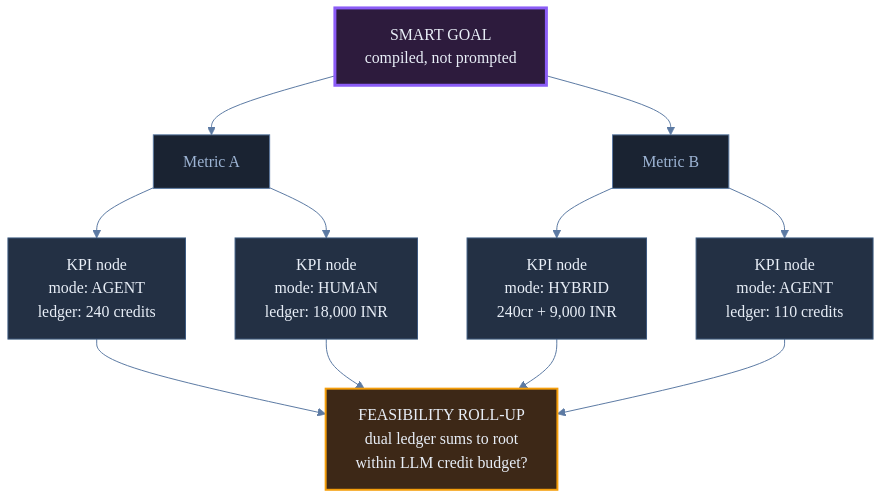
Note what each leaf carries: an explicit executor mode (AGENT, HUMAN, or HYBRID) and its own entry in two cost ledgers that never merge — human_cost_inr and agent_spend_credits. Human time and machine spend are different currencies with different constraints; collapsing them into one number is how plans lie to you.
Feasibility then falls out as a roll-up, not a bolted-on gate: the dual ledgers sum from leaves to root, and the plan is approved only if the aggregate sits inside budget. That is a property of a compiled structure. You cannot get it from a paragraph.
Underneath sit the frameworks that structure the decomposition:
- KPI-tree construction — the measurable spine of the goal.
- OKR tracking — bubbles node movement up to goal outcomes.
- RTM — requirements traceability for achievability.
And the proprietary algorithms that run them:
- Tracking Manager — updates OKRs as metrics move.
- Agent Skill Hashing — discovery-network search.
- Milestone Planner — re-adjusts plans as the tracker changes.
- Intelligence Discovery — finds MCP servers and skills.
- Adapter Builder — wires heterogeneous agents so their outputs compose.
The architecture: a master agent over a swarm
Astra runs the initiative as a loop — today a single master agent with five execution branches (market synchronization, competitor scanning, research validation, vibe coding, project tracking), each able to spawn sub-agents with their own loops. The deliberate path is toward a fully hierarchical architecture; the single-master design is the stable production form now.
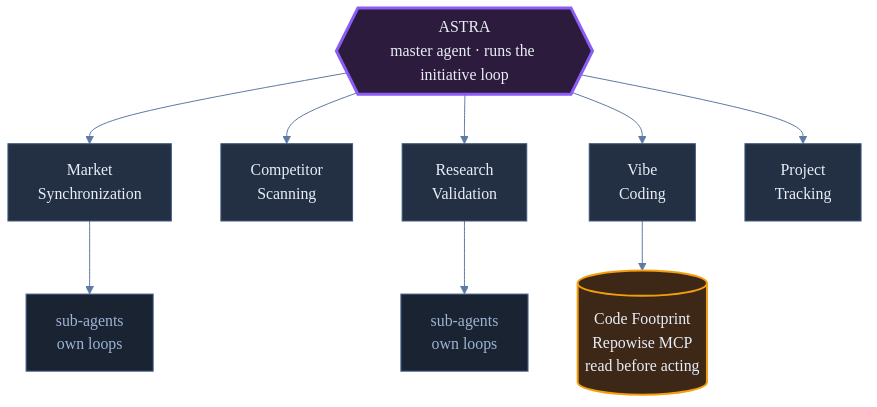
Every coding branch reads a code footprint before it acts — a commit-linked, machine-readable record mapping each feature to the exact files, routes, and DB entities it touches, served over a hosted MCP server (a forked, extended Repowise) queried by agents in production.
To be clear about what this is and isn't: code indexing and repo-aware context are not our invention or our moat. Cursor, and others heavily invested in code generation, have already made this excellent. We build a footprint layer because the engine needs one — an ECV dev-cost figure is only as honest as the file map under it, and a coding agent should read the impacted surface before touching it. It is table stakes we pay so the rest of the system can be grounded in real files rather than a model's imagination, not a wedge we are claiming.
The loop closes — and that is the point
A model in a workspace is an open loop: it produces an artifact and stops. Meridian is a closed loop — signal becomes a feature, the feature is validated before it is built, execution is tracked in dual ledgers, releases generate feedback, and feedback becomes new signal. Nothing enters as a "feature" without three pieces of evidence: a validated signal, a code footprint, and a commercial verdict. Missing any one, it is not a feature — it is a wish.
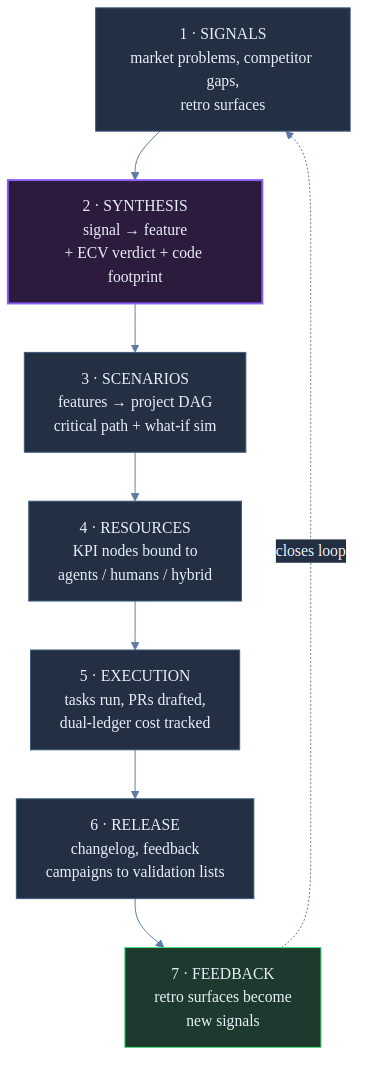
This is the founding lesson, encoded. Our prior company failed for a diagnosable reason: persistent misalignment between what the market needed, what engineering built, and what the codebase could support — three sources of truth that never reconciled. Meridian is the refusal to let them drift apart again, forcing the collision between market signal, commercial value, and code reality into the only path by which a feature can exist.
Why this compounds
Two of the durable advantages are not features a competitor ships in a sprint.
The data flywheel. Every hypothesis run through a domain agent — every survey that error-corrects the synthetic market, every validation response that sets a confidence prior, every ECV verdict later confirmed or refuted by real revenue — trains the next version. The engine gets more accurate with use. A prompt does not.
Crystallized expertise, rentable per run. The platform play is an agent marketplace of three classes: validation agents (domain-specific — fintech, healthtech, tourism — priced per response volume and domain tier), coding agents (assignable to tasks, producing PRs through the footprint-anchored pipeline), and synthesis agents (domain-lens variants of the product synthesizer). Expertise once locked in specialist heads becomes rentable capability. Two of our early cohort asked, unprompted, when fintech and healthtech agents would ship — the demand exists before the supply.
The asymmetric bet: today a human PM, tomorrow an agent PM
The frontier is shifting from "build what people love" to "build what agents want," for a structural reason: software is now written by agents faster than humans can coordinate it. The bottleneck is no longer generation — it is the absence of a shared, machine-readable map of what software actually does and what it is for.
Meridian is architected for human coherence today, and the same architecture is what agent-to-agent coordination needs tomorrow. We did not pivot toward that future; it arrived underneath what we already built.

The mapping is exact. Today a founder reads a footprint and an ECV verdict to decide what to build; tomorrow a planner agent reads the same verdict and queues the task, and a coding agent reads the same footprint before editing a file. The seven surfaces that are a UI for a human become an API for an agent. The consumer changes; the underlying structure does not.
That is the thesis: Meridian is not "AI for product management" — too small a frame. It is the architecture for coordination between intelligent systems, human or agent. The model is a component, and a powerful one; we run frontier models throughout the stack. But the thing that turns fragmented capability into economic value is the engine wrapped around the model — the compilers, the filters and rankers, the schedulers, the ledgers that have to balance.
Search was not a better web page. It was the layer that made the web usable. The Value Engine is not a better model — it is the layer that makes the coming abundance of agents deliver value. That layer is where durable value has always accrued.
Meridian is built by Nestafar Technologies. The Value Engine runs in production today across two onboarding compilers, five Astra execution branches, and a persistent code-footprint MCP layer.